Thoughts
-
The Invisible Wall That Cuts Off the Bigger Cake
History always moves upward in a spiral.
There's a wall between businesses and their customers. The deeper you go inside one circle, the easier it is to get caught up in its insiders' self-congratulatory bubble.
A business that only hears its insiders ends up building only for them.
1
I have a lot of interests, so I stand in a lot of circles.
Most of them are small. Over the years I noticed something about the ones that grow and have become popular. They are always the ones that are easy to enter, and the people inside are willing to help whoever just walked in.
Then there is the other kind. The veterans look down on newcomers. The businesses keep making things for the veterans. And everyone complains that no new people are coming.
I have watched one circle of each kind up close.
There is a game called jubensha. The name means "script murder". A group of friends books a room in a shop. Each person gets a booklet with a character's story and secrets. You play that character, and together, guided by a host, you work out who the murderer is. It came from British murder mystery games. In 2013 one of them, Death Wears White, was translated into Chinese. In 2016 a hit reality show, Who's the Murderer, put the format on TV. But in China it became a completely different thing. You did not have to buy a kit, host at home and organise your friends. The shop gave you the room, the host and the table; anyone could walk in. It was built as a four or five hour game, and a seat cost 30 to 80 yuan at that time.
It was supposed to be easy to enter, and for a while it was.
Today, in the shops I have played at, a session runs eight hours or more on average. Some run twelve. Some run fifteen. A seat costs 200 to 300 yuan on average and some go far higher, because the new, complicated games need more hosts, more actors and a room for the whole day.
Almost all the new ones are made for veterans, and nobody has the patience to play with a newcomer. A veteran does not want to spend hours on a simple game that no longer attracts them, and explain everything along the way. So a first try now costs a full day and several times the money. The circle gets smaller. And the people inside keep asking why nobody new is coming. Outside China it is the same picture. In Vancouver a seat costs 80 to 120 Canadian dollars on average, and still only Chinese people play.
Bouldering is the circle I have watched grow.
Bouldering gyms always do an orientation for newcomers. I guess that is mostly to keep everyone safe, so the gym stays out of trouble. Whatever the reason, a first-timer walks in and gets shown how to start.
And you can always see the same picture: a veteran in fancy, high-level climbing shoes teaching a newcomer in the shoes the gym provides. They show the beta, the body positions, how to use strength, the rules, how to read a route.
It would be easy to say one circle has kind people and the other has arrogant ones. I don't think that is the whole story.
Jubensha is much more complicated to teach. A game made for newcomers is not attractive to a veteran, and it takes hours. In bouldering a veteran can still be happy on a simple route, so helping a newcomer costs them nothing.
The shops are not stupid either. The veterans have the loudest voices, and the shops are afraid to lose the only customers they have left. So they keep making things for the veterans, fighting over the existing pie, instead of making something simpler that would make the cake bigger.
Every step makes sense, and the sum is a circle that shrinks.
2
We have come to the end of an era. Everyone is fighting over the existing market instead of looking for new opportunities and new growth. Big companies squeeze the space small companies live in. Companies squeeze the space their employees live in. Job seekers have to out-compete each other for the same seats. In Chinese we call this neijuan (内卷, involution), and it slowly becomes bigger and more meaningless.
The whole society lives in more and more anxiety. People find it harder and harder to get by. Nobody can afford a house, a car and a child anymore. Marriage rates and birth rates keep falling.
And that is part of the reason why I still believe AI will bring a new, flourishing era. AI can ease this strange, distorted, negative cycle, and maybe even break it.
A circle grows when it is cheap to enter and cheap to welcome someone in. Bouldering has that by nature. Jubensha had it, and built a wall. What AI brings is knowledge equity and technology equity: things that used to take a veteran years are now within reach of a newcomer.
It is now possible for everyone to make the cake bigger.
So instead of following the anxious mood and tense atmosphere around the development of AI, I personally think this is actually one of the best eras in human history. It is chaotic, but not in a dangerous, wartime way. Right now is the growing pain of an era, a transition. Maybe in a few years everything will move toward stability and get better again.
History always moves upward in a spiral.
-
Inside the Black Box
The world has started to feel like the black box inside the models.
Two days ago I was in the middle of an infographic comparing two AI models when two more came out. Anthropic had just released Claude Opus 5.5, which it says performs at the level of its three-week-old flagship, Fable 5.1, on most work. Within two hours OpenAI put out GPT-6 Sol and Luna at half what developers had been paying for the versions before them.
That made seven major launches in three weeks, among them Meta’s Muse, an app that books travel and fills in forms, and TypeSafe’s Jev, which skips the chat and hands back decisions. Grok 4.7 arrived the day before Opus, about three weeks after Elon Musk said it was ten days away.
I’ve had a feeling for two or three years that I still can’t put into words. I love building with AI, and it lets me make things I couldn’t have made before; then I get stuck on how anyone would ever find them; then another model launches, and I wonder whether it just made what I’m building pointless before I’ve even shipped it, or whether the next one will. Every one of those launches also has people with jobs wondering whether it’s coming for theirs.
And all of it lands on top of everything else, the politics and the wars, markets swinging on a single post, the biggest names in tech fighting in public, each headline arriving before the last one has sunk in… until it all runs together into complete chaos. The world has started to feel like the black box inside the models; some days I can’t even say where the problem starts.
For those years the change arrived one launch at a time, slow enough to live with. September played it all back like a time-lapse, and I happened to be drawing one frame when the next one arrived.
A contest of guesses
The black box inside the models is the famous one. In 2025 Anthropic’s CEO, Dario Amodei, wrote that people outside the field “are often surprised and alarmed to learn that we do not understand how our own AI creations work.”
My sense of the other black box, the world, is that it has gotten too big for anyone to follow, with more players than ever and more ways for them to affect each other. History pushes back on part of that. Long before AI, the economist Friedrich Hayek argued that nobody had ever understood the whole economy, because the knowledge it runs on “never exists in concentrated or integrated form.”
Size matters less, I think, than the fact that the world reacts to being predicted. A weather forecast doesn’t change the weather, so better models keep improving the predictions. Forecasts about people change what people do. If everyone trusted a model that said a stock would jump tomorrow, they’d buy today, and the jump would happen today, so the forecast undoes itself. Others make themselves come true. Tell enough people a bank is in trouble and they’ll pull their money out until it is. Either way, better AI may not make a world like this easier to read, since a better forecast of something that reacts just gets acted on sooner.
John Maynard Keynes described this loop with a kind of newspaper contest. Readers picked the six prettiest faces out of a hundred photographs, and the prize went to whoever came closest to the average choice. The way to win is to guess what everyone else will guess. Since they’re all doing it too, you end up, in Keynes’s words, devoting your intelligence “to anticipating what average opinion expects the average opinion to be.” In a game like that, the facts explain surprisingly little, which may be why reasoning my way through with them felt so useless.
Most of the black box I’d been feeling is made of this. Everyone acts on guesses about everyone else’s guesses, and each guess changes what’s being guessed. The AI race runs on it. In September Amodei published an essay called “We Must Pace the Frontier,” warning that “a race to the bottom, spurred by commercial incentives, can make these risks more acute.” It proposes that companies coordinate limits on the pace. Anthropic calls Opus 5.5 its first release since that essay, and OpenAI’s two models followed it within two hours. Even a lab arguing for a slower race wants the slowing done together, because of what it expects the others would do with a head start.
I suspect a lot of the talk about slowing down is about keeping competitors out. In March 2023 Elon Musk signed an open letter calling on AI labs to pause, for at least six months, the training of anything more powerful than GPT-4. Earlier that month he had incorporated xAI, the company that went on to build Grok. The pattern is older than AI. Laws that closed bars and liquor stores on Sundays were backed by Baptists, on moral grounds, and by bootleggers, who got Sundays to themselves. The economist Bruce Yandle called this “bootleggers and Baptists,” and nothing stops one person from being both.
I can’t prove it, though, and the race is the reason. A sincere CEO who can’t slow down alone and a cynical one who wants rivals slowed would sound alike and keep shipping in the meantime. You have to watch what they do, and even then most of what they do is what the race forces on everyone. OpenAI and Anthropic both set records for lobbying Washington in the second quarter of 2026, which either kind of CEO would do. The only telling move is one a cynic wouldn’t make, a commitment that costs the company real money and gets kept for years. By that test, the part of Amodei’s essay I’d watch is the one step Anthropic says it will take on its own, before anyone else agrees. If it still costs them something in a few years, that will say more than the essay does.
Keynes’s contest is ninety years old. What seems new to me is how many are playing, and who. Three years ago the models mostly waited for a prompt and replied. Now Muse, in Meta’s words, “keeps working after people close the app,” and Jev hands back decisions with probabilities attached. Some of the players we’re all trying to predict are now systems that, by Amodei’s own account, nobody fully understands. That’s the part I can’t find in Hayek’s world, and it’s why I still think this time is different, four words with a famously bad record in markets.
Uncertainty itself may be the worst part. Researchers at University College London had people turn over virtual rocks that sometimes hid a snake, and a snake meant a painful electric shock. Their stress peaked when the odds were around fifty-fifty, higher than when a shock was certain. A world where every forecast gets acted on as soon as it’s made leaves mostly what nobody can call either way, the kind of uncertainty that study found hardest to bear.
“Worldly wisdom teaches,” Keynes also wrote, “that it is better for reputation to fail conventionally than to succeed unconventionally.” Being wrong along with everyone else is forgivable in a way that being wrong alone isn’t. I think a lot of what we call FOMO is the fear of being the one who guessed differently. In 2025 nearly two-thirds of chief executives told IBM that the risk of falling behind pushes them to invest in some technologies before they understand the value. The more people pile into identical bets to avoid that, the more the outcome depends on the crowd.
What you can’t buy today
The forecast only undoes itself because the stock can be bought today. Outside markets there’s no price ticker, but copying does what those buyers did. Whatever can be built fast gets built by everyone who sees it coming, and its value is competed away almost as soon as it appears. AI keeps moving things into that category. A working app or a month of posts can now be had in an afternoon, and TypeSafe’s price list calls Jev’s output “FREE (too cheap to meter).”
In a paper on competitive advantage, the strategy professors Ingemar Dierickx and Karel Cool tell of an American visitor asking a British lord how he got such a gorgeous lawn. The lord lists the soil, the seed, the fertilizer, the daily watering and the weekly mowing, and the American keeps saying no problem. “Oh, absolutely,” says the lord. “There is nothing to it, old boy; just keep it up for five centuries.”
Their name for this is “time compression diseconomies.” It means you can’t get the same result by doing twice as much in half the time. A reputation, an audience that trusts you, a client who’s worked with you for years and a track record all have to be accumulated, and none of them can be built in an afternoon at any price. Even a perfect forecast that trust will matter doesn’t let anyone get ahead of it, because the only way to build trust is to spend the years.
Whole economies have slow parts too. Machines improve much faster than people, and the Stanford economists Chad Jones and Christopher Tonetti show that most past productivity growth came from handing them more of the tasks people used to do. Even when most tasks are automated, the ones people still do hold the rest back. Jones compares the economy to a chain that is “only as strong as its weakest link.” In their data, computing power has exploded, yet since 2000 the share of US business income paid to computers has fallen, from about 4.3% to 3.0%. If AI makes the fast parts of work nearly free, the value moves to the slow parts, which cap what the whole can produce and end up taking most of what it costs.
Building got easy and getting seen got hard, and I’d been treating those as two separate facts. They’re one. Attention doesn’t speed up. People still have only so many hours in a day to look at things, and when everyone can build, everyone is bidding for those hours.
Thread after thread says distribution is the new moat. I believe it, which is the trouble. Any moat everyone agrees on is already priced in, like the stock everyone bought a day early. Everyone piles into distribution with identical tools, and the parts anyone can copy, the posts and cold emails AI can turn out by the thousand, get flooded first. What keeps its value is the part nobody can copy quickly, people who already trust you because you’ve been showing up for them long enough. (I’m aware that writing a long essay like this one is my own attempt at that part.)
The test I take from this, for anything I build, is to ask what part of it next month’s model would do for free. When I run it on my own projects, the first things to fail are workarounds that newer models now handle on their own. What passes is smaller and slower, like knowing a particular problem well because I’ve lived with it for a while.
Nothing stays slow
Making slow things fast is what this technology is for. Jones, who took a job at Anthropic starting in mid-2026, writes that if AI “eventually automates away nearly all the weak links in the economy,” growth could pass 5% a year. For 150 years, he notes, US income per person has grown a steady 2% a year. Anthropic says one tester of Opus 5.5 finished a 680,000-line code migration in less than a day, work that would have taken an engineering team weeks. Agents can already do a lot of checking, one of the slowest parts of almost any job. An agent picking your hotel can read every review and compare every price far faster than you could, which covers a lot of what a hotel’s reputation used to do.
Every launch moves the answers, so the test has to be asked again each time. I suspect most products that get swallowed by a launch were built on something that was slow when they started and fast by the time the models caught up. That’s exactly what I’m afraid of with every launch. So a better rule is that value moves to whatever can’t be sped up yet.
Guessing where the line between fast and slow will go next is its own contest of guesses. Everyone is trying to work out what AI won’t be able to do, and the answers pile up in a few places, like taste, judgment, trust and relationships. A safe spot everyone agrees on gets crowded as soon as it’s named, as distribution did.
Companies are guessing where the line will be, too, and the fear of replacement may be the self-fulfilling kind of forecast. UK executives surveyed in mid-2026 said AI had raised their firms’ productivity by less than 1% so far, yet they expect nearly 3% more over the next three years and more than 1% fewer staff. If firms cut staff on gains they only expect, and the gains come in smaller than hoped, some of the replacement people fear will have come from the forecast itself.
Does anything stay slow, however good the models get?
Promises
I can’t picture any model speeding up the future. Agents keep getting faster at checking the present, whether the code runs or the citation exists, but nobody, human or machine, can check the future before it arrives. When you trust someone, you’re betting on what they’ll do later, that they’ll fix the thing when it breaks and still be around next year. The evidence is mostly a record of promises kept, plus someone you can hold to them, and a record takes as long as it takes. An agent can read a hotel’s whole record far faster than you could, but it can’t make the record any older. And while everyone can agree today that trust matters, nobody can agree their way into five years of kept promises, any more than the American could hurry the lord’s lawn. None of that guarantees anyone will pay for a record like that, only that nobody can produce one quickly.
The philosopher Hannah Arendt described two sources of unpredictability in human affairs. One is “the basic unreliability of men who never can guarantee today who they will be tomorrow.” The other is that when everyone can act, nobody can foresee what any act will lead to, which is Keynes’s contest again. Her remedy for both was “the faculty to make and keep promises,” which sets up “islands of security” in “the ocean of uncertainty, which the future is by definition.”
Her islands are the slow parts. The black box is us predicting each other, and a kept promise is one of the few places where we can stop.
A promise needs someone who’ll still be around to keep it and who can be held to it. At September’s pace even a top model can be superseded within weeks, and no model can be held to anything, so when something built with AI goes wrong, it’s a person’s promise that’s broken. A public database of court decisions about AI-invented material in legal filings, mostly fake citations, lists more than 2,000 cases, and in almost all of them it’s a lawyer or someone representing themselves who answers to the court.
For people with jobs, being answerable may be the slow part that’s left. Drafting is fast now, but you can only put your name on what you’ve understood well enough to defend, and those two thousand court cases show what happens when people skip that step.
If what keeps its value is made of kept promises, and a promise about what a product will do can expire with the next launch, what can anyone still promise? Arendt thought promises only work as islands, and that once they’re stretched “to cover the whole ground of the future,” they lose their binding power. The only promise I can make honestly is the slow kind, that I’ll still be around to fix what I build. What I don’t know yet is whether that’s worth anything to someone who can get next month’s model for free.
Sources and notes
Launches. Anthropic, Claude Fable 5.1 and Mythos 5.1 (Sept 1, 2026) and Claude Opus 5.5 (Sept 22), which calls Opus 5.5 “the new leading model” and “our first release since we called for pacing the frontier,” and is the source of the 680,000-line migration. GPT-6 Sol and Luna (Sept 22): SiliconANGLE says OpenAI released them “minutes later” and “halved the price of both new models against the GPT-5.6 versions that carried the same names”; TechCrunch puts the gap at about 90 minutes. OpenAI’s announcement on its Developer Community forum cites “50% lower API prices for Sol and Luna compared with GPT‑5.6 promotional pricing.” GPT-6 Astra (Sept 3) is the seventh launch, dated by SiliconANGLE. SpaceXAI (formerly xAI), Grok 4.7 (Sept 21); Musk’s timeline as reported by Decrypt via Yahoo Tech. Meta, Introducing Muse (Sept 8). TypeSafe AI, Introducing System One Models & Jev (Sept 15), including the price list. Performance and price claims are the companies’ own.
Opacity. Dario Amodei, “The Urgency of Interpretability” (April 2025).
Hayek. F. A. Hayek, “The Use of Knowledge in Society”, American Economic Review 35(4), 1945.
Forecasts that change what they forecast. Machine-learning researchers call this performative prediction. Juan Perdomo, Tijana Zrnic, Celestine Mendler-Dünner and Moritz Hardt, “Performative Prediction”, ICML 2020: “When predictions support decisions they may influence the outcome they aim to predict.” Moritz Hardt and Celestine Mendler-Dünner, “Performative Prediction: Past and Future” (2023, revised May 2025, to appear in Statistical Science): “Predictions in the social world generally influence the target of prediction,” with self-fulfilling and self-negating predictions as examples. The stock and bank-run examples are standard illustrations.
The beauty contest. J. M. Keynes, The General Theory of Employment, Interest and Money (1936), chapter 12, the source of both Keynes quotes.
Pacing. Dario Amodei, “We Must Pace the Frontier” (September 2026). It proposes a first step Anthropic takes on its own (embedded evaluators), then coordination among companies in democratic countries, then global coordination.
The pause letter and xAI. Future of Life Institute, “Pause Giant AI Experiments: An Open Letter” (March 22, 2023), which Musk signed. X.AI Corp was incorporated in Nevada on March 9, 2023, as Forbes reported from state filings; SpaceX acquired it in 2026 and renamed it SpaceXAI.
Lobbying. Luke Fountain, “OpenAI, Anthropic boost lobbying as legacy tech and defense spending slips”, CNBC (July 21, 2026), from federal lobbying disclosures: $3.17 million combined in the second quarter of 2026, a record for both companies (Anthropic $1.97 million, OpenAI $1.2 million).
Bootleggers and Baptists. Bruce Yandle, “Bootleggers and Baptists: The Education of a Regulatory Economist”, Regulation 7(3), May/June 1983. Applying it to AI labs, and the point that sincere and cynical players act alike in a race, are my reading.
“This time is different.” The phrase’s record is the subject of Carmen M. Reinhart and Kenneth S. Rogoff, This Time Is Different: Eight Centuries of Financial Folly (Princeton University Press, 2009), on the “this-time-is-different syndrome” that recurs before financial crises.
Uncertainty and stress. de Berker and colleagues, “Computations of uncertainty mediate acute stress responses in humans”, Nature Communications 7 (2016).
FOMO, in a survey. IBM Institute for Business Value, 2025 CEO Study (with Oxford Economics; 2,000 CEOs in 33 countries, February–April 2025): “64% of CEOs surveyed acknowledge that the risk of falling behind drives investment in some technologies before they have a clear understanding of the value they bring to the organization.” It is a self-reported survey.
Time compression. Ingemar Dierickx and Karel Cool, “Asset Stock Accumulation and Sustainability of Competitive Advantage”, Management Science 35(12), 1989. Applying it to trust and audiences is my extension.
Weak links. Charles I. Jones and Christopher Tonetti, “Past Automation and Future A.I.: How Weak Links Tame the Growth Explosion” (working paper, version 0.5, May 2026): “Even when most tasks are automated by rapidly-improving capital, output is constrained by the tasks performed by slowly-improving labor.” The computer share of income is their Figure 2, from Bureau of Labor Statistics data on the private business sector: it rose from about 3.7% to 4.3% in the late 1990s and fell to 3.0% after 2000. Charles I. Jones, “AI and Our Economic Future”, Journal of Economic Perspectives 40(3), Summer 2026, is the source of the weakest-link comparison, the 5% scenario and the 2% figure. Disclosure: the article notes that after it was completed, Anthropic contacted Jones about joining the company, and that from June 30, 2026 he would be on leave from Stanford and the NBER, “working at Anthropic as a paid employee.” Linking weak links to where value goes is my reading.
Executives’ expectations. Yotzov, Barrero, Bloom and coauthors, Firm Data on AI (working paper, 2026), with UK figures from the authors’ July 2026 World Bank presentation of the May–June 2026 Decision Maker Panel: 0.6% higher productivity so far, 2.7% more expected over the next three years, and 1.3% lower employment. These are executives’ own estimates, cumulative over three years, with productivity measured as sales volume per employee.
Promises. Hannah Arendt, The Human Condition (1958; 2nd ed. 1998), chapter V, pp. 237 and 244.
Court cases. Damien Charlotin, AI Hallucination Cases Database: 2,077 decisions as of Sept 23, 2026, in cases where generative AI “produced hallucinated content – typically fake citations.” Its filter lists 1,196 involving self-represented litigants and 825 involving lawyers.
References
Almeida, D. (2026, September 15). Introducing System One models & Jev. TypeSafe AI. https://typesafe.ai/blog/introducing-system-one-models-and-jev
Amodei, D. (2025, April). The urgency of interpretability. https://darioamodei.com/post/the-urgency-of-interpretability
Amodei, D. (2026, September). We must pace the frontier. https://darioamodei.com/post/we-must-pace-the-frontier
Anthropic. (2026a, September 1). Introducing Claude Fable 5.1 and Claude Mythos 5.1. https://www.anthropic.com/claude-fable-and-mythos-5-1
Anthropic. (2026b, September 22). Introducing Claude Opus 5.5. https://www.anthropic.com/claude-opus-5-5
Arendt, H. (1998). The human condition (2nd ed.). University of Chicago Press. (Original work published 1958)
Charlotin, D. (n.d.). AI hallucination cases database. Retrieved September 23, 2026, from https://www.damiencharlotin.com/hallucinations/
de Berker, A. O., Rutledge, R. B., Mathys, C., Marshall, L., Cross, G. F., Dolan, R. J., & Bestmann, S. (2016). Computations of uncertainty mediate acute stress responses in humans. Nature Communications, 7, Article 10996. https://www.nature.com/articles/ncomms10996
Dierickx, I., & Cool, K. (1989). Asset stock accumulation and sustainability of competitive advantage. Management Science, 35(12), 1504–1511. https://doi.org/10.1287/mnsc.35.12.1504
Fountain, L. (2026, July 21). OpenAI, Anthropic boost lobbying as legacy tech and defense spending slips. CNBC. https://www.cnbc.com/2026/07/21/openai-anthropic-ai-lobbying-spending-q2-2026.html
Future of Life Institute. (2023, March 22). Pause giant AI experiments: An open letter. https://futureoflife.org/open-letter/pause-giant-ai-experiments/
Hardt, M., & Mendler-Dünner, C. (2023). Performative prediction: Past and future. arXiv. https://arxiv.org/abs/2310.16608
Hayek, F. A. (1945). The use of knowledge in society. American Economic Review, 35(4), 519–530. https://oll.libertyfund.org/titles/hayek-the-use-of-knowledge-in-society-1945
IBM. (2025, May 6). IBM study: CEOs double down on AI while navigating enterprise hurdles [Press release]. https://newsroom.ibm.com/2025-05-06-ibm-study-ceos-double-down-on-ai-while-navigating-enterprise-hurdles
Jones, C. I. (2026). AI and our economic future. Journal of Economic Perspectives, 40(3), 3–22. https://web.stanford.edu/~chadj/AIandEconomicFuture.pdf
Jones, C. I., & Tonetti, C. (2026). Past automation and future A.I.: How weak links tame the growth explosion [Working paper, version 0.5]. Stanford Graduate School of Business. https://web.stanford.edu/~chadj/JonesTonetti_Automation.pdf
Keynes, J. M. (1936). The general theory of employment, interest and money. Macmillan. https://www.marxists.org/reference/subject/economics/keynes/general-theory/ch12.htm
Lanz, J. A. (2026, September 21). xAI launches Grok 4.7. It’s bigger, but late to the AI frontier party. Decrypt, via Yahoo Tech. https://tech.yahoo.com/ai/gemini/articles/xai-launches-grok-4-7-171603280.html
Meta. (2026, September 8). Introducing Muse: The world’s first personal AI agent built for everyone. Meta Newsroom. https://about.fb.com/news/2026/09/introducing-muse-personal-ai-agent/
Novak, M. (2023, April 14). Elon Musk forms new AI company in Nevada called X.AI. Forbes. https://www.forbes.com/sites/mattnovak/2023/04/14/elon-musk-forms-new-ai-company-in-nevada-called-xai/
Perdomo, J., Zrnic, T., Mendler-Dünner, C., & Hardt, M. (2020). Performative prediction. In H. Daumé III & A. Singh (Eds.), Proceedings of the 37th International Conference on Machine Learning (Vol. 119, pp. 7599–7609). PMLR. https://proceedings.mlr.press/v119/perdomo20a.html
Reinhart, C. M., & Rogoff, K. S. (2009). This time is different: Eight centuries of financial folly. Princeton University Press. https://ideas.repec.org/b/pup/pbooks/8973.html
Riley, D. (2026, September 22). Anthropic releases Claude Opus 5.5 and OpenAI counters with two cheaper GPT-6 models. SiliconANGLE. https://siliconangle.com/2026/09/22/anthropic-releases-claude-opus-5-5-and-openai-counters-with-two-cheaper-gpt-6-models/
Ropek, L. (2026, September 22). OpenAI launches GPT-6 Sol and Luna, boasting lower cost and fewer mistakes. TechCrunch. https://techcrunch.com/2026/09/22/openai-launches-gpt-6-sol-and-luna/
SpaceXAI. (2026, September 21). Introducing Grok 4.7. https://x.ai/news/grok-4-7
VeitB. (2026, September 22). Announcing GPT-6 Sol and GPT-6 Luna in the API, Codex and ChatGPT [Online forum post]. OpenAI Developer Community. https://community.openai.com/t/announcing-gpt-6-sol-and-gpt-6-luna-in-the-api-codex-and-chatgpt/1399925
Yandle, B. (1983). Bootleggers and Baptists: The education of a regulatory economist. Regulation, 7(3), 12–16. https://www.cato.org/sites/cato.org/files/serials/files/regulation/1983/5/v7n3-3.pdf
Yotzov, I., Barrero, J. M., Bloom, N., Bunn, P., Davis, S. J., Foster, K. M., Jalca, A., Meyer, B. H., Mizen, P., Navarrete, M. A., Smietanka, P., Thwaites, G., & Wang, B. Z. (2026a). Firm data on AI (Working Paper 2026-3). Federal Reserve Bank of Atlanta. https://www.atlantafed.org/research-and-data/publications/working-papers/2026/03/24/03-firm-data-on-ai
Yotzov, I., Barrero, J. M., Bloom, N., Bunn, P., Davis, S. J., Foster, K. M., Jalca, A., Meyer, B. H., Mizen, P., Navarrete, M. A., Smietanka, P., Thwaites, G., & Wang, B. Z. (2026b, July 7). Firm data on AI [Presentation slides]. ECA Talk, World Bank. https://thedocs.worldbank.org/en/doc/b903ff39ad0d4337d085f1c70106c125-0080062026/original/slides-ecatalk-firmdataai-july2026.pdf
For a concrete project on reusable agent creation and verification workflows, see Agent Skills.
-


Slate Grey
3:24 in the afternoon
I hadn't expected the story of the car window's edge to have a sequel.
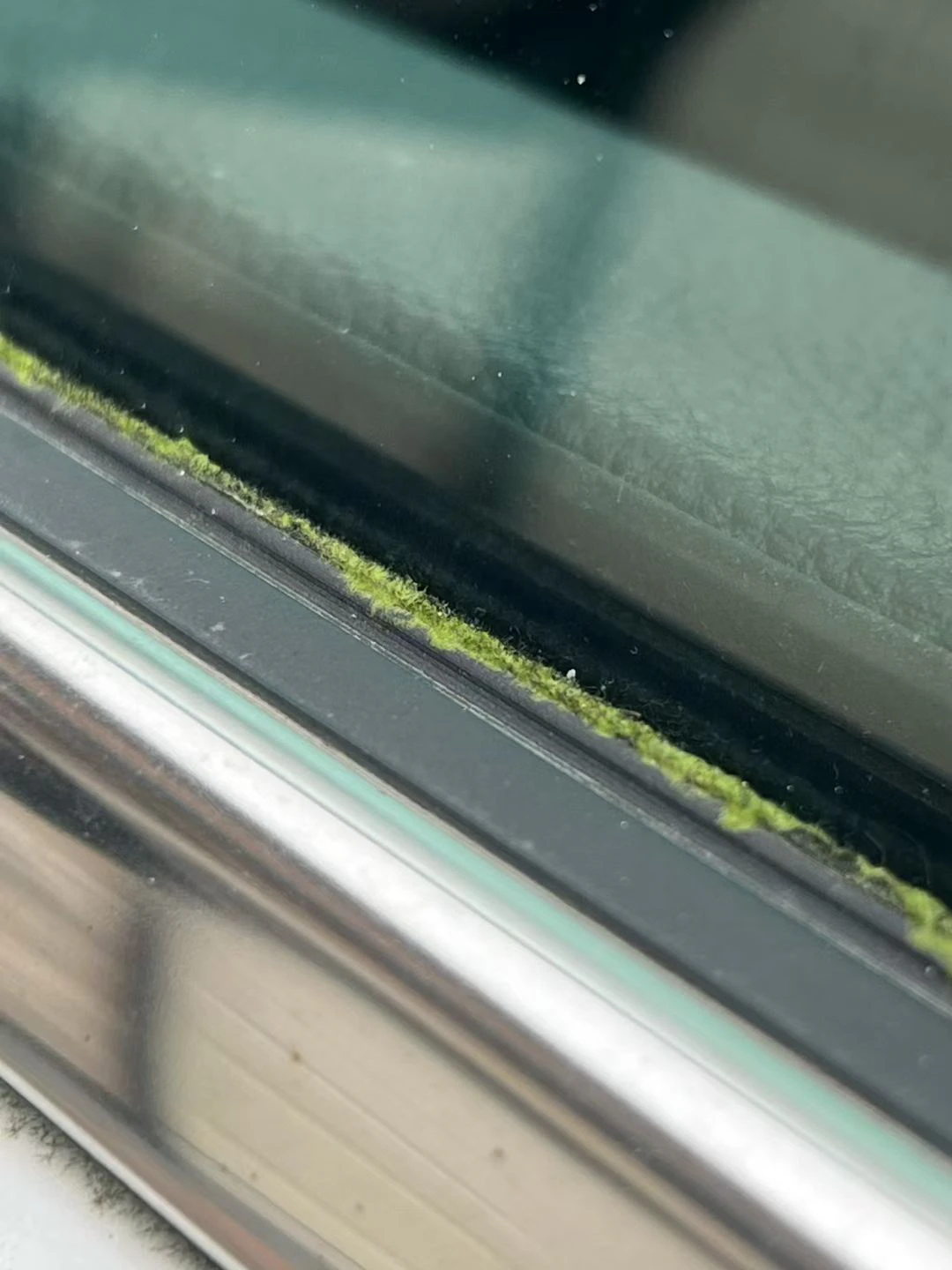
The rainy season seems almost over, and moss has sprouted in the crack of the car window—look closely and it's a little troop of furry clusters.
Last year's glittering ice crystals have not yet dimmed, and already another year has slipped by.
Today, rare for me, I didn't drive out. I walked slowly along the river when a sudden chill caught me off guard; only when I checked my phone did I discover it had already dropped to zero.
Vancouver still hasn't seen snow. We are always hoping for snow, hoping that something wonderful and unforeseen might suddenly fall into our lives, the way a child hopes for candy and gifts to sprout inside a Christmas stocking.
What we hope for does not happen, and what we fear does not happen either—only what has already happened happens. Like the new fragrance I bought smelling so good, like the piano music playing in the tea house sounding so lovely, like the braised pork rice at noon tasting so fine, like the big white dog outside the floor-to-ceiling window running along, tugging a little girl behind it, like some matter I'd agonized over for so long finally being let go.
Perhaps we ought to allow things to happen without needing them to serve either your interests or mine; allow the concrete to triumph over the abstract. A person cannot arrive at understanding except through the concrete experience of living.
Perhaps the world moves as my heart moves. Last year I said the sky was slate grey, I said the shards of ice would keep glittering until the sun rose.
Now the moss before my eyes reflects no light, and so the whole expanse of slate-grey sky has been absorbed into a faint, grassy hue.
That thread of slate grey has crept, just so, along that same line, filling every corner of life, carrying with it a certain dampness, though no droplet can be seen.
Light without glare, still waters running deep.
Like water vanishing into water.
-
The Gown We Can't Take Off
More 'Choices', Less Freedom.
I clicked into a random gaming video.
The YouTuber had hundreds of thousands of followers. I watched him play for a while, and his gameplay was painfully bad. I had an annoying feeling that came out of nowhere suddenly: He didn't even seem to realize what he was doing wrong, and just kept blaming the game and the devs.
I closed the YouTube tab, frustrated, like a rage quit from another 'stupid' gamer. I started thinking: how many of the people watching him are actually much better analytical thinkers than he is? Maybe someone just finished ten hours at a law firm. Someone else spent the day writing code, building financial models, doing research, designing something, or solving problems at work. They get home exhausted, open YouTube, and watch this guy fail at a fairly obvious problem.
So, why does YouTube seem to have so few "intelligent" people?
Actually, being bad at a game doesn't mean someone is stupid. Becoming a successful YouTuber itself requires abilities that traditional schools and companies often don't measure very well: storytelling, timing, charisma, consistency, understanding audiences, emotional value, and the willingness to expose yourself to public judgment. And having an impressive degree or a prestigious job doesn't automatically make someone intelligent either. Different parts of society are simply selecting for very different kinds of people.
Traditional prestigious careers tend to reward a fairly recognizable package of traits:
- Do well in school
- Accumulate credentials
- Delay gratification
- Avoid catastrophic mistakes
- Get into a respected university
- Get into a respected company
The creator economy rewards another package:
- Be interesting
- Take risks
- Put your face on camera
- Produce constantly
- Survive embarrassment
- Learn what people actually pay attention to
- Accept that thousands of strangers may judge you
- Build something without knowing whether it will work
There is intelligence involved in both worlds, but they are filtering for different things.
Success makes change scary
And perhaps there is another filter that appears once someone succeeds in the first world. The more status you accumulate, the harder it becomes to do something that looks like moving backward. Imagine spending your childhood competing for grades, getting into a good university, earning a difficult degree, landing a prestigious job, and finally becoming the person your family and peers always expected you to become.
Then one day you decide you actually want to make gaming videos.
Technically, you have more options than before. Psychologically, you may feel like you have fewer. Because leaving your career doesn't only mean giving up a salary. It is like giving up your 'successful' social identity. You have to explain yourself to your parents, your classmates, your colleagues... And maybe to yourself: "You went through all of that just to do this?"
The risk is no longer purely financial; it becomes reputational. And suddenly the education and achievements that were supposed to expand your freedom can start defining the boundaries of an acceptable life.
The story of Kong Yiji
That is what made me think about a Chinese internet trend of recent years: Kong Yiji (孔乙己).
Kong Yiji is the title character of a 1919 short story by Lu Xun. He is a poor scholar who never passed even the lowest level of the imperial exams. In the tavern where the story is set, laborers in short jackets drink standing at the counter, while men in long gowns, the clothing of the educated, sit down in the room next door. Kong Yiji is the only man who drinks standing up in a long gown: a dirty, torn one that looks like it hasn't been washed or mended in ten years. He is too poor to sit with the gowns, and too proud to become one of the short jackets.
The gown was his identity as a scholar. Even when his actual life had collapsed, he couldn't really separate himself from what it meant. More than a century later, Chinese internet users revived that image with the idea that a degree can become "the long gown that I cannot take off": something that raises you up while simultaneously making certain kinds of work feel beneath the identity you have acquired.
Sometimes status becomes a cage precisely because we value it. The cage is originally from the environment, and gradually forms and grows inward. It is built out of expectations, sunk costs, other people's opinions, our own pride, and a fear that choosing an unconventional life means wasting everything that came before it.
What tired viewers want
Or maybe I'm just overthinking. The exhausted professional watching that gaming video may not even want a more intellectual video. After ten hours of thinking, maybe the last thing they want is to think harder. After all, watching someone else play a game is one of the easiest ways to switch off after a stressful day.
So perhaps the system makes perfect sense.
During the day, one group of people is rewarded for optimizing credentials, productivity, precision, and professional status. At night, another group is rewarded for optimizing attention, personality, entertainment, and emotional value. And the first group comes home and watches the second.
Platforms don't particularly care which group is "smarter." YouTube describes its recommendation system in terms of things like appeal, engagement, and viewer satisfaction. If people click, stay, enjoy themselves, and come back, the content has done its job.
People choosing the safe road never try
So maybe my original irritation at that YouTuber was pointing at the wrong person. There is somebody I considered stupid who managed to get hundreds of thousands of followers. Good for him, honestly: He took the camera, made something, and found an audience.
The more interesting question is how many capable people never try something they genuinely want to do because it doesn't fit the life they believe they are supposed to live. How many people who could become filmmakers, musicians, writers, YouTubers, founders, craftsmen, researchers, or something we don't even have a respectable job title for instead choose the path that is easiest to explain at a family dinner?
This doesn't mean everyone should quit their job and become a creator. Stability has real value; most risky projects fail. Professional careers can be meaningful, intellectually satisfying, and genuinely loved. And many people simply have no desire to put their lives online. There is nothing wrong with choosing the safe road.
What feels strange is when the road was never consciously chosen.
When somebody spends twenty years becoming successful according to a definition they inherited, then becomes too afraid to find out whether they would have defined success differently themselves.
Maybe the modern long gown isn't education.
Maybe it isn't Wall Street, Silicon Valley, medicine, law, consulting, or any particular career either.
Maybe the long gown is the belief that once you have become a certain kind of person, you have to keep performing that person forever.
And sometimes having more to lose can quietly mean becoming less free.
-

Shimmer
3:27 a.m.
The snow still hasn't come this year.
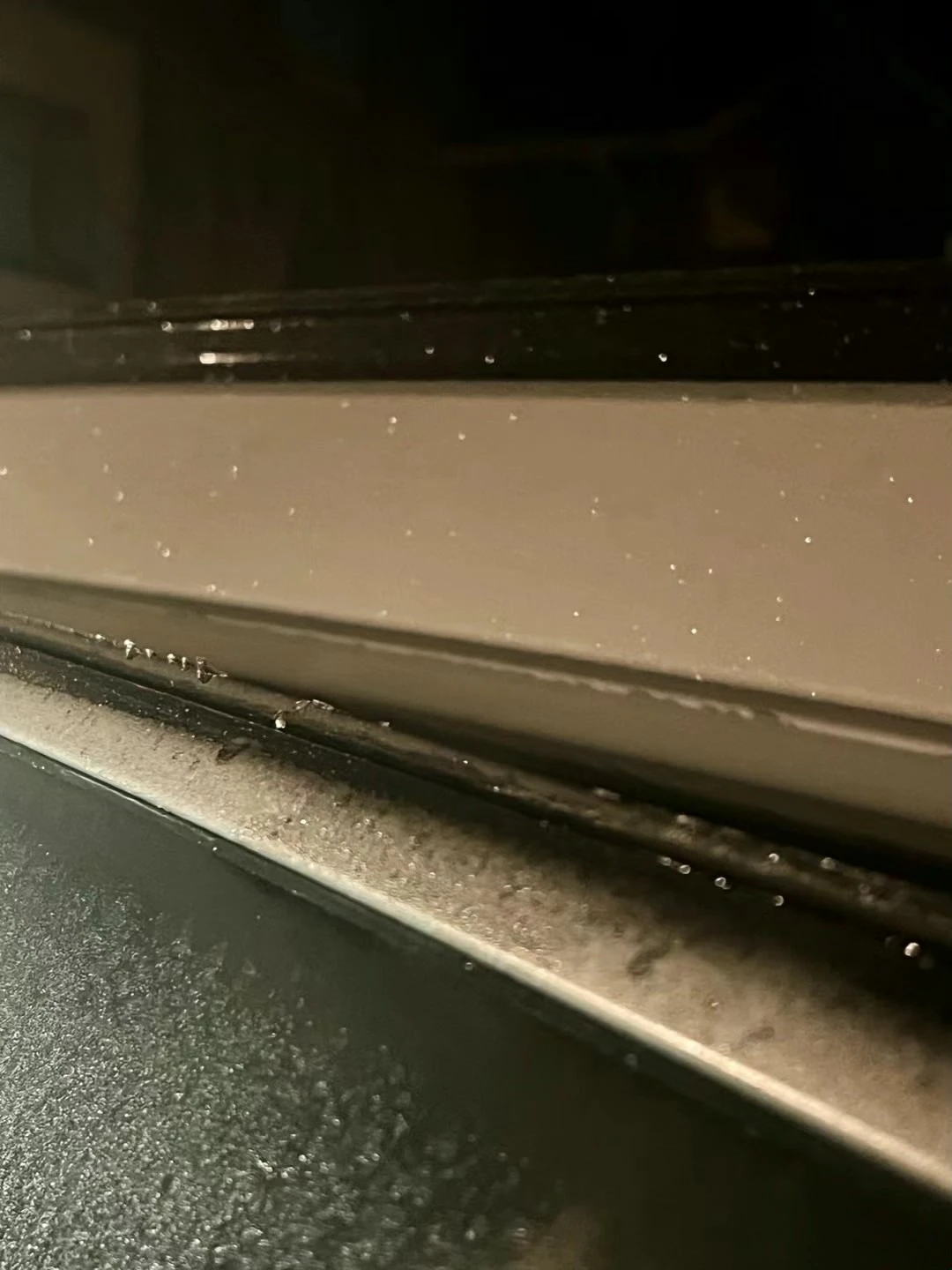
When I opened the car door there was a distinct resistance, and when I pulled harder it creaked, and a thin crust of ice chips came leaping down in a little procession. Glittering.
I let out a long breath, and a streak of white drifted away.
So a sigh can be seen, after all.
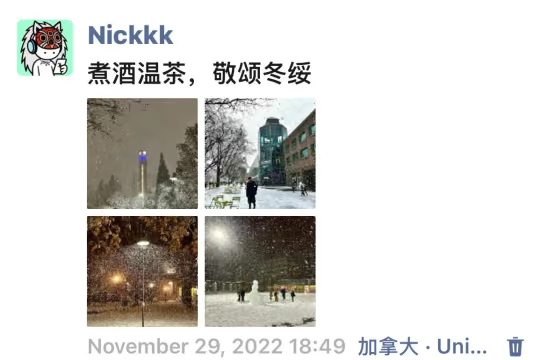
It reminds me of the year before last, the first time I watched the snow fall in Vancouver, when the caption I wrote for my friends was "warm the wine, steep the tea, and greet the winter's peace." I don't really know what that line means. I think I'd seen it somewhere once, and it simply surfaced from nowhere just as I was taking those snow photos, and it felt fitting.
Last year there was almost no snow, and this year it seems there won't be much either. In these golden days, time seems to have lost its weight, grown as light as the ice chips on the car door. Time is continuous; the new year, too, will go on as always—the stroke of midnight is no dividing line in a life. And yet there must always be something to look forward to; across the long years, such anticipation settles like sediment in time, and grows only more haunting.
I shut the car door, and I can see that layer of ice once more.
The night air is cold enough to let it go on shimmering along the curve of the car's edge, all the way until the sun comes up.
Like a river. The Milky Way.
And then that line surfaces again, for no reason at all.
"The whole universe will glimmer for you."
-
The Lie of Endless Summer
The endless summer of the millennium came to an end.
The autumn wind blew across the gradually withering sea of flowers, carrying away the lie of endless summer, scattering longing and memory.
……
The youths of days long past, unseen for so long, gathered once more in that old clubroom.
They had all grown up now, and beside them was a group of children as spirited and bright-eyed as they themselves had once been. The middle-aged man at the head of the group spoke slowly, telling the children the story of those years. The children listened with great interest, now and then striking a pose of deep thought, chiming in, vying to answer the little riddles the man posed.
"If it wasn't him who did it, then why did this 'Endless Summer' hydrangea turn up at the scene?"
The boy who was clearly the ringleader of the pack rolled his little eyes round and round.
Suddenly, as if struck by some idea, his eyes lit up.
"It must have been a yōkai who killed him!"
Inside the room, on the small square table, a sugar cube spun and dissolved in a cup of coffee.
The wooden photo frame standing to one side was somewhat old, but had fortunately, it seemed, been carefully polished, and looked very clean. In the photograph, the youths' backs were still full of buoyant joy and hope.
Just as, outside the photograph, the little ones sat gathered round the table.
Outside the room, the wind rose again, ushering in another season of high summer.
The endless sea of blue flowers remained deep and unfathomable, like the tide of the ocean, rising and falling, ebbing and flowing, without end...
-
Mr. Deer
"One thousand and seven, one thousand and eight."
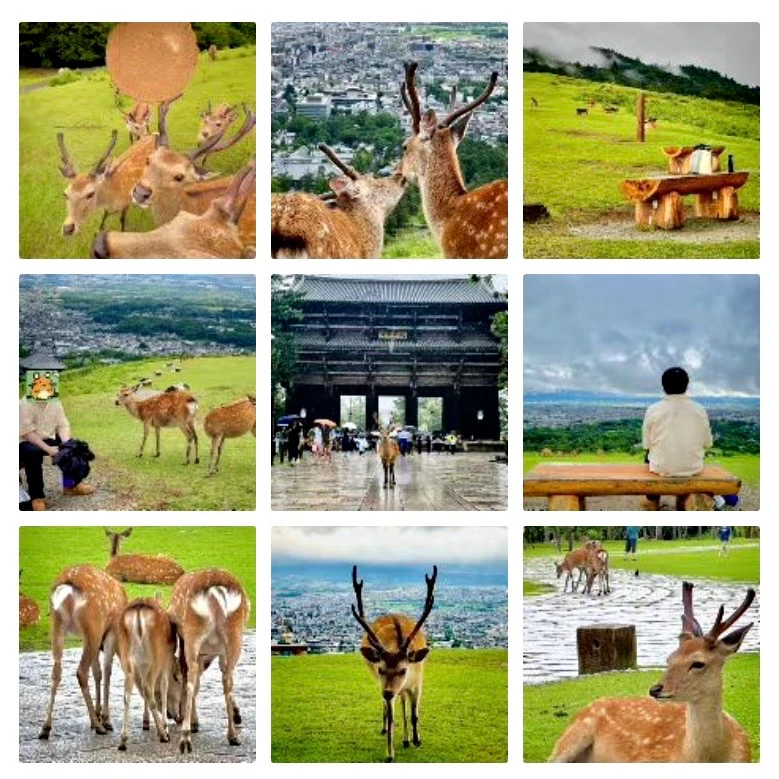
Mr. Deer atop the mountain gave a yawn and went on counting the two-legged beasts he'd seen that day. Though he wasn't counting heads, but legs—lifting his head was such a bother.
The newly arrived two-legged beast before him showed no sign of producing a deer cracker.
He chewed on his grass as usual, gazing down at Nara Park at the foot of the mountain. There too was a herd of his own kind, every one of them fat and sleek, sprawled lazily by the roadside—hardly deer-like at all anymore. "Not a shred of ambition," thought Mr. Deer. "If I had endless deer crackers to eat every day, I'd surely have the strength to go see what lies beyond the mountain, instead of just basking in the sun like that pack of fools."
At this thought he yawned again. It had rained a little today, and fewer two-legged beasts had come up the mountain.
Fewer deer crackers too.
"Might as well go down the mountain myself," he said, spitting out the leaf he'd been bitterly chewing. "Grandfather was right—you can't eat pride for a deer cracker." The breeze atop the mountain was pleasant enough, but a pity it still carried that same rank smell of mud when it entered his mouth. Deer-forsaken nuisance. He clicked his tongue. "Ah, forget it. The way down is quite far—can't have my knees worn raw."
Besides, it was still raining today.
"Tomorrow, then. I'll go down tomorrow."
Mr. Deer glanced up at the crow circling overhead, gave a third yawn, and lay down.
The newly arrived two-legged beast before him still showed no sign of producing a deer cracker.
-
Autumn When the Bellflowers Fade
This is the final roar of a detective from a bygone era.
Surveillance cameras now blanket every street and alley; DNA technology grows more mature by the day.
People no longer have need of this once far-famed, gold-medal detective.
Perhaps he still wished to shine, but all that remained of his era was the last glow before the sun sank below the horizon. He was like a candle nearly burned to its end—its flame about to die—clutching the wick tight, straining to burn on a little longer, and then a little longer still. No one paid it any mind. A torch can still pass on people's convictions, can still be a light in the world of the spirit. But he—he had nothing at all. He had been cast aside.
He had tried to struggle on. He chased after it with all his might, unable to let go of the glory that once was his. His moods began to turn extreme; beneath the calm surface of his sea, the waves ran wild.
He was the tip of an iceberg.
But his iceberg had already laid itself bare before everyone's eyes.
His hidden portion lay beneath the surface of the sea. He was an iceberg turned upside down.
The waves kept rolling forward, knocking down both him and the last pride he had left.
The new era had no ship large enough to hold him.
Kawashima Sōsei drove his white Toyota Corolla up to the cliff's edge.
"Time to log off." He gazed at the distant forest, not knowing to whom he spoke.
He stepped down and out. Just as he had, once, the very first time he walked out of police headquarters.
-
A Young Ship on a Long Voyage
The FBOA 2.0 era has passed.
"It feels like we met only yesterday" may be a worn-out line, but that National Day holiday in 2020 is still vivid to me. Even now it leaves me feeling that life is a dream and the past drifts off like smoke, the feeling of "Master Zhuang, dreaming at dawn, lost in the butterfly."
It was my first turn from taking part in business competitions to organizing them. When I had finished my work, the founder called me, knowing nothing beforehand, into a meeting, with a mysterious curve at the corner of his mouth; remembering it now, I can still share a knowing smile with the person I was then: "You can't leave. You come with me too." And so I boarded FBOA's great ship on its long voyage, and so began the youth that belonged to the 2.0ers: naive, reckless, and dazzling.
I never thought of myself as that thousand-mile horse worth being discovered. To tell the truth, there is a question about his choice that I have always kept to myself: why me. Beside the brilliant records of the other 1.0ers and 2.0ers, and abilities to match, the very best among our peers, I seemed to have simply played in a few more business competitions and somehow become someone who could stand alongside these outstanding people.
Perhaps that is why, in the first days of the new team, I weighed every word and step, like a relative from the countryside come to the city: everything was a novelty, and everyone was new. Luckily the outstanding ones were all warm in private, we soon became close, and I gradually found my own place on FBOA's great ship.
Under pressure from both the pandemic and the school, from "五人同裤裙" ("Five in One Pair of Culottes", the name of our WeChat group back when there were only five of us) to the arrival of a new partner, we boldly reworked every 2.0 competition: new, fun, and naturally, challenging. The seas were often rough, and this great ship kept moving forward. Meetings still going late at night, work already under way at dawn: too many to count. Whatever the results, I enjoyed the process: a group of people beside you, all working toward the same goal. That feeling was wonderful.
I am so grateful to this team, or rather, this big family: its openness and harmony gave me so much reassurance and help. The nine partners on the same ship, and him, a teacher and a friend, someone I call "teacher" from the bottom of my heart, and each of you, every one of you, will surely shine in your own futures.
1.0ers, 2.0ers, 3.0ers: young and outstanding, you are still on the road.
"Gou Ge" (狗哥),
Academic Chair, FBOA 2.0.
2021.8.23